

Point-of-Care Ultrasound in South African Practice
Dr. Yahya Docrat, MBChB
Founder and Clinical Director at Ultrascan Technologies. Anaesthesiologist and POCUS educator with clinical practice across South Africa.
Point-of-care ultrasound (POCUS) has quietly transformed clinical decision-making across the world over the past two decades. In South Africa, the shift is underway, but it is happening unevenly. Emergency physicians in major academic centres are scanning routinely at the bedside, while general practitioners in peri-urban settings may still refer every ultrasound to a radiology department three suburbs away. Understanding where POCUS stands in South Africa today, what is holding it back, and where the opportunities lie is essential for any clinician considering adding this capability to their practice.
The South African Healthcare Landscape
South Africa operates a dual healthcare system unlike almost anywhere else in the world. Approximately 16% of the population uses private healthcare, which is among the most expensive per capita on the continent, while the remaining 84% depend on the public sector, which is chronically underfunded and understaffed. This split creates radically different environments for POCUS adoption.
In well-resourced private hospitals, clinicians have access to radiology departments, sono-technologists, and specialist imaging services. The question there is not whether imaging is available, but whether POCUS can offer faster answers at the bedside, reduce radiology turnaround times, and allow more targeted referrals. In the public sector, especially at district and community health centres, the question is more fundamental: imaging simply may not be available at all. Rural district hospitals may lack any on-site ultrasound, with referral pathways stretching hours by road.
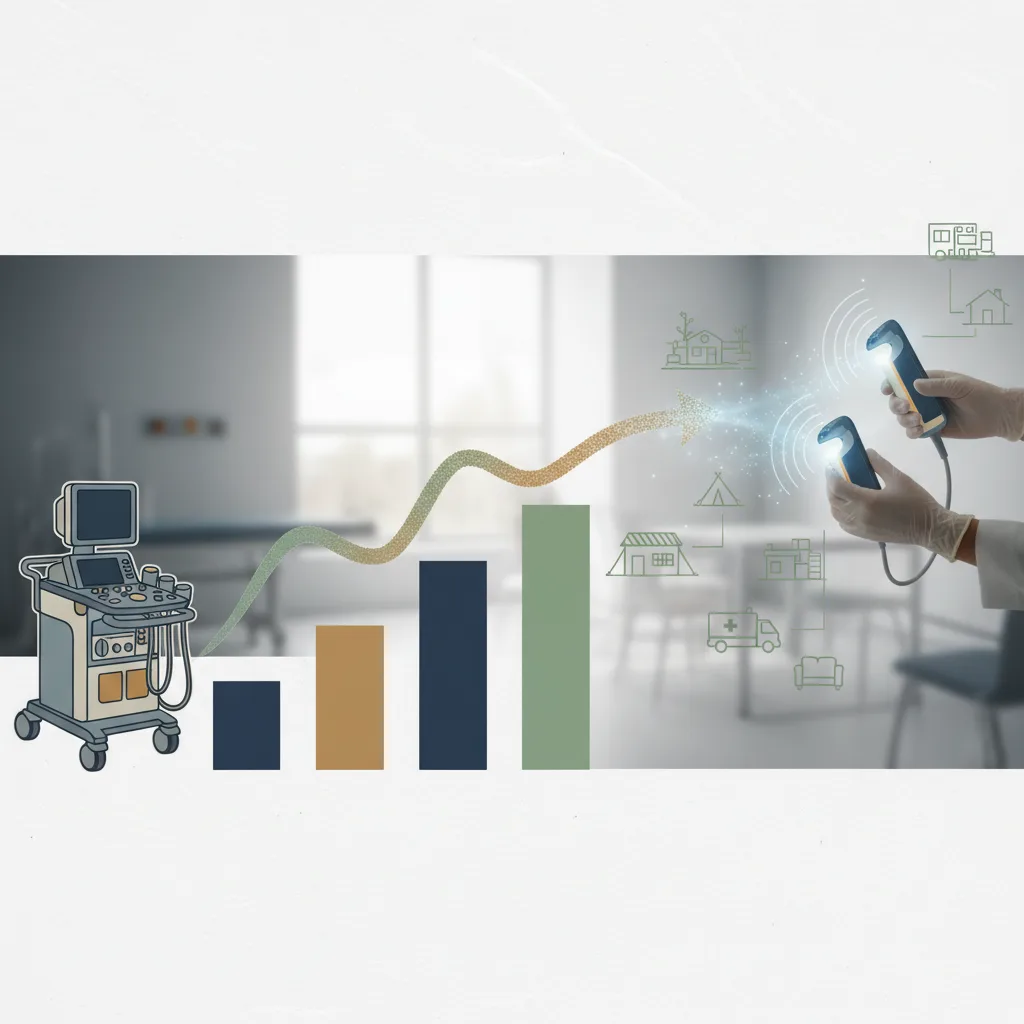
This is where POCUS becomes genuinely transformative. A compact, wireless probe that pairs with a smartphone represents a fundamentally different cost and logistics profile compared to a wheeled cart system requiring a dedicated room, three-phase power, and a trained sonographer. The barriers to placing diagnostic capability at the point of care are dramatically lower.
Current POCUS Adoption in South Africa
POCUS adoption in South Africa is driven primarily by emergency medicine and critical care. The Emergency Medicine Society of South Africa (EMSSA) has been the most active professional body, developing the ePOCUS credentialing framework and integrating ultrasound into emergency medicine training curricula. Emergency physicians trained over the past decade in South Africa have almost universally received some POCUS exposure during their registrar years.
Outside emergency medicine, adoption is more fragmented. Anaesthesiologists increasingly use ultrasound for regional nerve blocks and vascular access, driven partly by safety evidence and partly by medical negligence considerations. Some intensivists perform focused cardiac and lung assessments in ICU settings. General practitioners and family physicians represent a largely untapped population for POCUS, despite having potentially the most to gain from point-of-care diagnostic capability.
Obstetrics is a special case. Viability scans, lie and presentation assessment, and placenta localisation are core obstetric functions, and handheld convex probes are increasingly used in antenatal clinics at district level, particularly in nurse-led settings supported by training programmes.
If you are exploring which device suits your specialty, visit our specialties page for a breakdown by clinical area.
Key Barriers to Wider Adoption
Cost and Subscription Models
The most frequently cited barrier to POCUS adoption in South Africa is cost. Traditional cart-based systems cost between R500,000 and R2,000,000, placing them firmly outside the reach of most private practitioners and most district hospitals. Even the generation of wireless probe systems that dominated the market between 2018 and 2022 introduced mandatory annual subscription fees, which added R10,000 to R30,000 per year to the total cost of ownership. For a clinician in a price-sensitive market, a subscription fee that never ends on top of an already significant capital outlay made the numbers difficult.
The emergence of no-subscription wireless probes has changed this calculation materially. Devices like the Ultrascan US-CL deliver dual-frequency wireless scanning with no ongoing licence fees, meaning the total cost of ownership over five years is simply the purchase price. This is a more legible and manageable financial commitment for both private practitioners and healthcare facilities.
Training and Credentialing
Having a device is not sufficient on its own. POCUS requires trained operators who can acquire adequate images, interpret findings within clinical context, and recognise the limits of their competence. Formal training pathways in South Africa remain under-developed relative to the United States, United Kingdom, and Australia, where specialty societies have produced extensive credentialing frameworks.
EMSSA's ePOCUS programme represents the most structured pathway available locally. Online didactic modules, simulation workshops, and supervised clinical scans form a tiered curriculum. The Colleges of Medicine of South Africa have also incorporated POCUS elements into emergency medicine fellowship examinations. However, for non-emergency physicians, formal credentialing pathways are less well defined, which can create uncertainty about scope of practice.
Ultrascan provides clinical onboarding support for every device purchased. Our education resources include training guides, video demonstrations, and guidance on connecting with POCUS training programmes in South Africa.
Regulatory Environment
All medical devices sold in South Africa require registration with the South African Health Products Regulatory Authority (SAHPRA). This is a meaningful quality safeguard, and it means that not every low-cost device available internationally is legally available to South African clinicians. Ultrascan devices carry full SAHPRA registration alongside CE marking and FDA clearance, providing regulatory assurance for institutions and individual practitioners.
Where POCUS Adds the Most Value in SA Contexts
The clinical applications that produce the most immediate and unambiguous value in the South African context include:
- Rapid assessment of undifferentiated hypotension (RUSH protocol) in emergency and peri-operative settings
- FAST and eFAST for trauma, given the high trauma burden in urban South Africa
- Obstetric viability scans and basic antenatal assessment in district and community settings
- Vascular access guidance for difficult peripheral and central lines
- Pleural and pericardial effusion detection in resource-limited settings where clinical examination alone is insufficient
- Renal colic triage to identify hydronephrosis and guide analgesia decisions
- Skin and soft tissue assessment in cellulitis, abscess, and foreign body cases
Evidence Supporting POCUS in Low-Resource Settings
The evidence base for POCUS in low-income and middle-income countries has grown considerably. The World Health Organization has recognised ultrasound as an essential component of primary healthcare, particularly for obstetric care, and has published recommendations supporting portable ultrasound deployment in settings where radiologist-performed studies are unavailable.
A systematic review published in the South African Medical Journal documented improved diagnostic confidence among clinicians using POCUS in emergency settings across multiple SA institutions, with particular benefit in the assessment of dyspnoea and undifferentiated shock. The WHO's manual on diagnostic imaging and a landmark study on POCUS in sub-Saharan Africa published in PLOS Medicine both reinforce the case for widespread deployment.
Getting Started
For South African clinicians considering their first POCUS device, the advice is straightforward: start with a clear sense of your primary use cases, choose a device that covers those applications without unnecessary complexity, commit to structured training, and build your scan volume systematically before expanding your scope.
The Ultrascan team works with practitioners across South Africa, from solo GPs in Cape Town consulting rooms to district hospital medical officers in Limpopo. We understand the local context and can guide you toward the right device and training pathway for your setting.
Reach out through our contact page to discuss your specific needs, or browse our device range to get a sense of what is available at South African prices with no subscription fees.
Visual Summary
Key concepts from this article at a glance.


Related Products
Related Articles
POCUS in Anaesthesia: Vascular, Gastric, Lung and Cardiac
A focused review of point-of-care ultrasound applications in anaesthesia practice.

Handheld Ultrasound in Private Practice: Lowering the Barrier
How wireless POCUS devices are making ultrasound accessible for private practitioners.
POCUS Governance: Training, Documentation and Quality Assurance
Building a sustainable POCUS program with proper governance, training standards, and quality review.