For South African Healthcare Professionals

POCUS Education Hub

Clinical training resources for South African healthcare professionals learning and advancing point-of-care ultrasound.

Last updated: April 2026

Training Principles

Why POCUS Training Matters

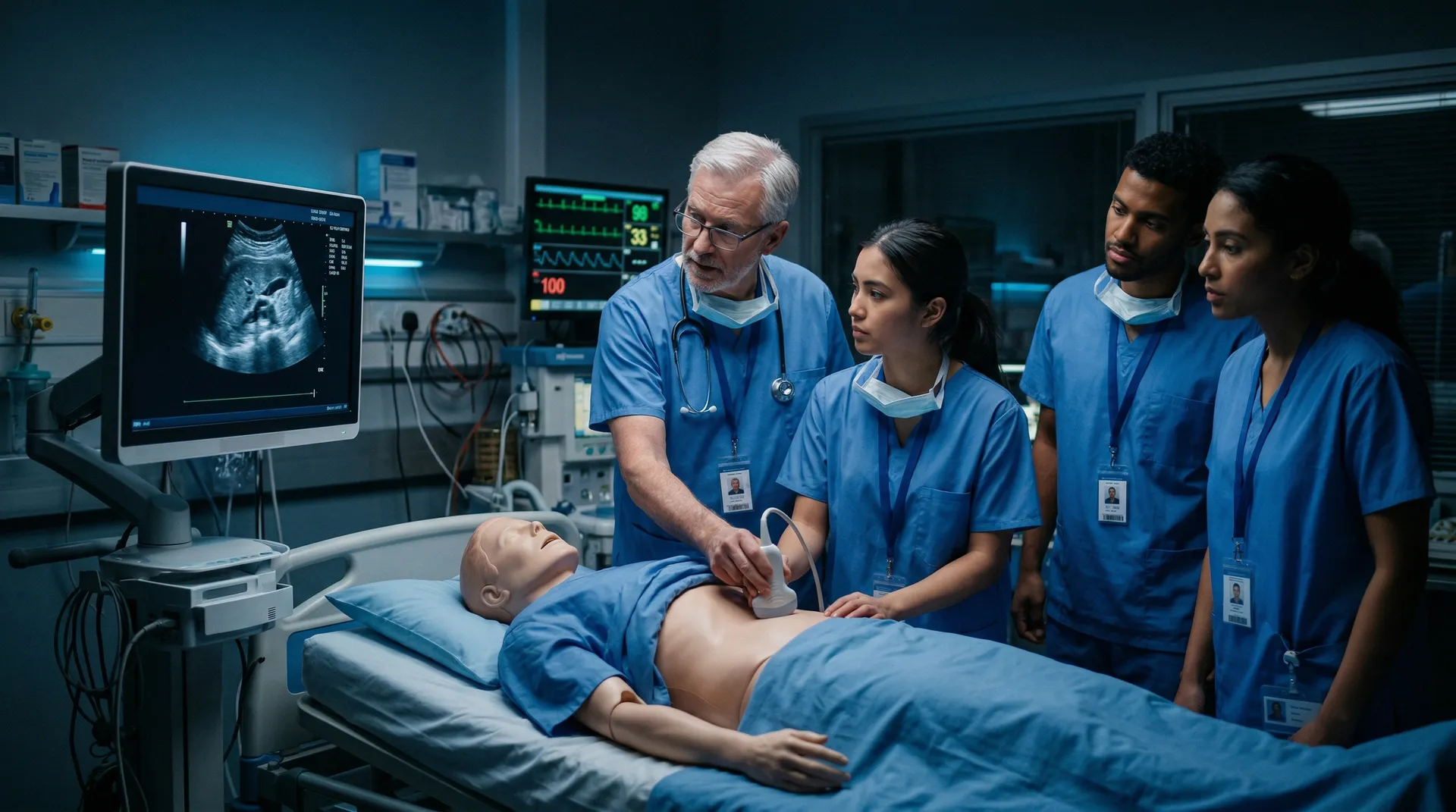
Acquiring a device is only the first step. Structured training transforms POCUS from a tool into a genuine clinical skill.

Patient Safety

Structured POCUS training reduces procedural complications and diagnostic errors. Clinicians who understand probe placement, image optimisation, and artefact recognition deliver safer care at the bedside.

Clinical Competence

POCUS is a skill that must be learned and maintained. Formal training pathways - from introductory workshops to specialty-focused courses - ensure clinicians build competence systematically and maintain it over time.

Cost Reduction

Trained POCUS clinicians reduce unnecessary specialist referrals, radiology requests, and hospital admissions. In a resource-constrained South African healthcare system, this translates directly into lower costs per patient episode.

Your Learning Path

From unboxing to advanced skills

A structured pathway from your first scan to clinical mastery.

01
Device Setup
30 min
Unbox, charge, and pair your probe with the Konted app on iOS or Android. Confirm Wi-Fi Direct connection.
02
Probe Orientation
1-2 hrs
Learn probe marker conventions, imaging planes, and how to hold the probe for abdominal, cardiac, and vascular windows.
03
First Scans
2-4 hrs
Perform supervised scans in your clinical context. Focus on image optimisation, gain, and depth settings.
04
Clinical Protocol
1 week
Integrate POCUS into your daily workflow. Build a personal protocol library for your most common presentations.
05
Advanced Skills
Ongoing
Attend Ultrascan workshops, access online modules, and connect with the South African POCUS community.
Explore Training

Training pathways

Five clinical pathways from basic POCUS to specialty protocols. Click to explore each pathway.

01Basic POCUS
PATHWAY 01
Basic POCUS
The foundation every clinician starts with. Master the FAST and eFAST protocols, basic lung ultrasound for B-lines and pneumothorax, and abdominal organ survey. Used in emergency departments, general practice, and ICU settings worldwide.
Probe handling
Orientation, grip, and marker conventions
FAST protocol
Four-view trauma scan for free fluid
eFAST extension
Add bilateral lung views for pneumothorax
Lung B-lines
Identify pulmonary oedema and consolidation
Abdominal survey
Gallbladder, kidneys, aorta, and bladder
02Cardiac Windows
PATHWAY 02
Cardiac Windows
Focused cardiac ultrasound for rapid bedside assessment. Learn four standard echo windows, global systolic function estimation, pericardial effusion detection, and IVC assessment for volume responsiveness. Critical for undifferentiated shock and cardiac arrest.
Parasternal long axis
LV, RV, aortic and mitral valves
Parasternal short axis
Cross-section at papillary muscle level
Apical 4-chamber
All four chambers, LV function estimate
Subcostal view
Pericardial effusion, RV assessment
IVC assessment
Diameter and collapsibility for volume status
03Vascular Access
PATHWAY 03
Vascular Access
Real-time ultrasound-guided vascular access reduces complications and increases first-pass success rates. Covers peripheral IV, arterial line, and central venous catheter placement using in-plane and out-of-plane needle guidance techniques.
Vessel identification
Distinguish artery from vein using compression
Peripheral IV access
Guided cannulation in difficult-access patients
In-plane technique
Long-axis needle visualisation end to tip
Out-of-plane technique
Short-axis cross-section needle guidance
Central line placement
IJ, subclavian, and femoral CVC insertion
04Regional Anaes.
PATHWAY 04
Regional Anaes.
Ultrasound-guided peripheral nerve blocks for anaesthesia and pain management. Visualise nerve bundles, surrounding anatomy, and real-time needle trajectory. Reduces local anaesthetic volume and improves block success rates compared to landmark techniques.
Nerve identification
Recognise nerve bundles vs vessels and tendons
Femoral nerve block
Inguinal crease approach for lower limb surgery
Brachial plexus block
Interscalene and supraclavicular approaches
Sciatic nerve block
Popliteal and subgluteal approaches
TAP block
Transversus abdominis plane for abdominal analgesia
05OB/GYN Protocol
PATHWAY 05
OB/GYN Protocol
Point-of-care obstetric and gynaecological ultrasound for first trimester assessment, fetal wellbeing checks, and pelvic pathology. Enables same-day clinical decisions in the consulting room without formal radiology referral.
Viability assessment
Confirm intrauterine pregnancy and cardiac activity
Gestational dating
Crown-rump length and mean sac diameter
Fetal presentation
Determine lie and position for delivery planning
Placenta localisation
Identify placental position relative to os
Adnexal assessment
Evaluate ovaries for cysts and ectopic pregnancy
By Discipline

Training by Specialty

POCUS training needs differ by specialty. Find the applications and workflows most relevant to your clinical discipline.

CPD for SA Clinicians

Continuing Professional Development

POCUS training qualifies for CPD points through recognised bodies including the Health Professions Council of South Africa (HPCSA). Accredited courses in emergency medicine, anaesthesiology, and general POCUS earn Category 1 CPD credits applicable to your annual maintenance requirements.

The South African Society of Emergency Medicine (SASEM) and the Southern African Society of Anaesthesiologists (SASA) both endorse structured POCUS training. Contact us to learn which accredited courses are available in your region.

Ultrascan works alongside training course providers to help clinicians access formal competency certification. Our clinical guides and online resources serve as supplementary material alongside formal CPD programmes.

HPCSA CPD

Accredited courses earn Category 1 credits toward annual maintenance requirements.

SASEM Endorsed

Emergency medicine POCUS training aligned with SASEM competency standards.

SASA Aligned

Anaesthetic POCUS pathways consistent with SASA professional guidelines.

Competency Certificates

Formal certification available through course partners after practical assessment.

Video Library

Video Resources

Video content is in production. Demonstrations, tutorials, and case studies will be available here shortly.

Coming Soon
Overview

Product Demo

Watch a full walkthrough of the Ultrascan wireless probe range - setup, connectivity, and image quality.

Coming Soon
Technique

Clinical Tutorials

Step-by-step scanning technique videos covering probe handling, window optimisation, and image interpretation.

Coming Soon
Cases

Case Studies

Real clinical case examples demonstrating how POCUS changed patient management at the point of care.

Get in Touch

Questions about training?

Our clinical team can point you to the right training resources, accredited courses, and CPD pathways for your specialty and region.

Contact Us