
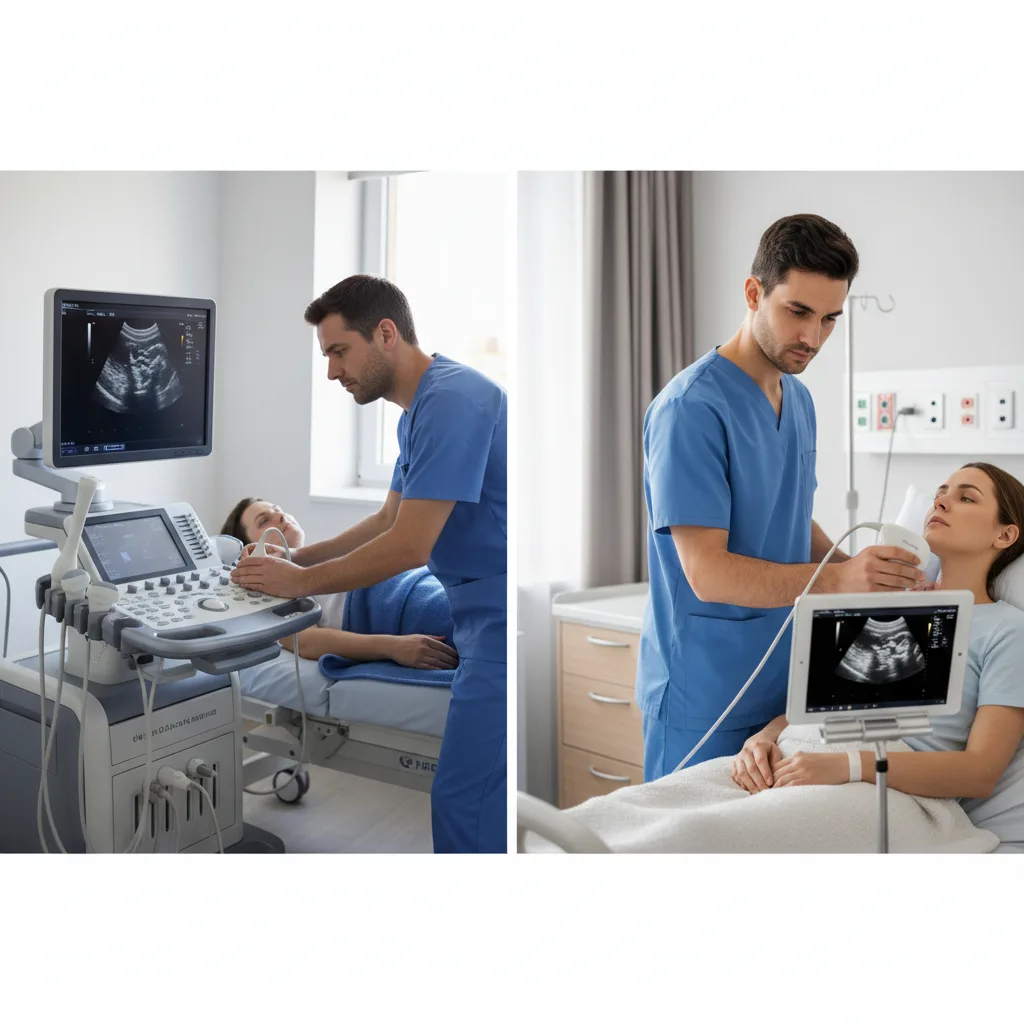
Handheld vs Cart-Based Ultrasound: An Honest Comparison
Founder & Clinical Director, Ultrascan Technologies
March 5, 2026 - 9 min read
The comparison between handheld wireless probes and traditional cart-based ultrasound systems is frequently framed as a contest, with one format about to render the other obsolete. The reality is more nuanced, and clinicians deserve an honest account of what each format genuinely does well, where each falls short, and how to think about the hybrid approaches that are increasingly common in well-resourced settings.
This is not an advertisement for handheld devices. It is an honest look at both formats from a clinical perspective, acknowledging that the right tool depends entirely on what you are trying to do and where.
Where Handheld Devices Excel
Speed and Portability
The most important advantage of a handheld probe is availability. A clinician with a wireless probe in their pocket can scan a patient in under two minutes, at the bedside, without booking, without waiting, and without transporting a patient who may be haemodynamically unstable. In emergency medicine, intensive care, and anaesthesia, this immediacy is clinically meaningful. The question "is there a pericardial effusion?" can be answered in the resuscitation bay rather than after a radiology referral that arrives six hours later.
Cost
The cost differential between a wireless probe and a cart-based system is substantial. Wireless probes range from approximately R70,000 to R80,000 for current Ultrascan devices. Cart-based systems from the same clinical tier cost R400,000 to over R2,000,000, with ongoing maintenance contracts, software licences, and hardware depreciation on top. For a solo practitioner, a rural hospital, or a specialty registrar setting up a private practice, the financial comparison is not close.
Focused Clinical Assessment
Handheld POCUS is ideally suited to focused clinical protocols: FAST trauma assessment, RUSH in undifferentiated shock, bedside cardiac windows, lung sliding assessment, deep vein thrombosis screening, and vascular access guidance. These are binary or semi-quantitative assessments designed to answer specific clinical questions, not comprehensive diagnostic studies. For these purposes, handheld image quality is entirely adequate.
Infection Control
A wireless probe is a single-element device that can be fully immersed in disinfectant, wiped down between patients with standard protocols, and carried between isolation rooms without the infection control challenges posed by a large cart moving between clinical areas. This is particularly relevant in ICU, COVID management, and resource-limited settings where decontamination infrastructure is limited.
Where Cart-Based Systems Remain Stronger
Image Quality and Spectral Doppler
Cart-based systems have more processing power, larger transducer arrays, and dedicated hardware for signal processing that current handheld devices cannot fully replicate. For comprehensive cardiac studies measuring ejection fraction precisely, assessing valvular gradients with spectral Doppler, or characterising complex vascular flow patterns, a cart-based system produces superior quantitative data.
This matters most in specialist cardiology, formal echocardiography, and detailed vascular studies. For the focused clinical questions that POCUS addresses, the image quality gap between a premium wireless probe and an entry-level cart has narrowed dramatically over the past five years. The gap to a high-end cart in specialist cardiology use remains real.
Comprehensive Diagnostic Studies
When a comprehensive abdominal sonography report is required, covering all organs systematically with measurements, Doppler flow characterisation, and formal documentation, a cart-based study with a trained sonographer produces the standard that radiologists, referring clinicians, and medical aid funders expect. Handheld POCUS is not a substitute for formal diagnostic ultrasound in this context, and it should not be represented as such.
Ergonomics for High-Volume Scanning
Sonographers performing 20 to 40 studies per day benefit from the ergonomic design of a cart-based system: adjustable screens, dedicated controls, multiple transducer ports, and purpose-built workstation layouts. High-volume scanning with a handheld probe held at arm's length for extended periods is less comfortable and introduces fatigue that can affect image acquisition.
The Hybrid Approach
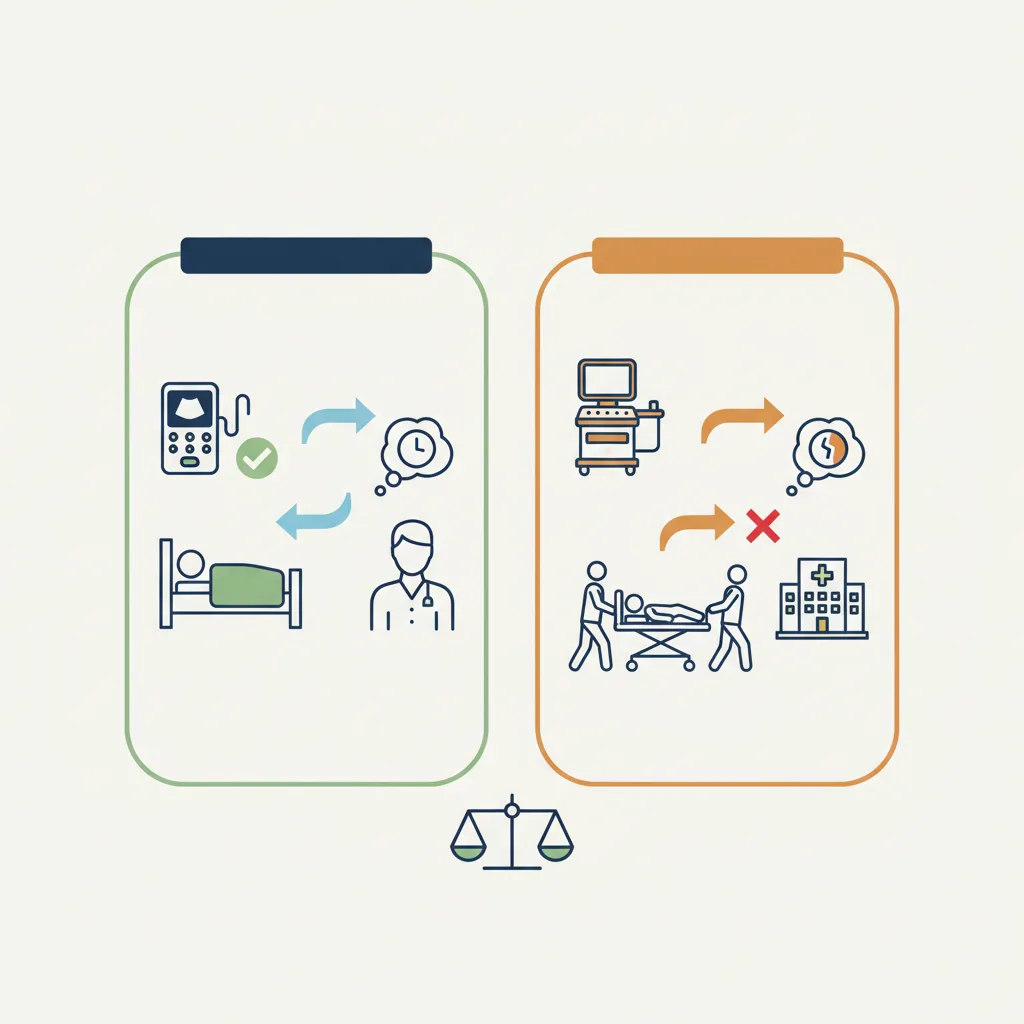
Many well-resourced departments are adopting a hybrid model: a cart-based system for formal studies and high-volume specialist imaging, supplemented by one or more wireless probes for rapid bedside assessment. In this model, the wireless probe handles the "rule in / rule out" decisions at the bedside, and the cart-based system handles comprehensive studies where detailed measurement and formal reporting are required.
This approach is increasingly common in emergency departments and ICUs. The wireless probe does not replace the cart; it extends clinical decision-making capability to the bedside without competing for the cart's time. The two formats complement each other rather than competing.
Total Cost Comparison
Over a five-year period, a rough total cost of ownership comparison for a private practitioner in South Africa looks like this:
- Wireless probe (no subscription): R70,000 to R80,000 once-off, no annual fees
- Wireless probe (with subscription): R50,000 to R80,000 purchase plus R8,000 to R30,000 per year, totalling R90,000 to R230,000 over five years
- Entry-level cart system: R400,000 to R600,000 purchase plus maintenance contract typically R20,000 to R60,000 per year, totalling R500,000 to R900,000 over five years
- Mid-range specialist cart: R1,000,000 to R2,000,000 purchase plus ongoing costs
For further detail on financing options available in South Africa, visit our finance page. The FAQ also covers common questions about total cost of ownership, Section 11(e) tax treatment, and medical aid billing.
What the Evidence Shows
A study published in Radiology compared diagnostic accuracy of handheld versus cart-based ultrasound across multiple clinical scenarios including pleural effusion, ascites, DVT, and gallstones. For the binary clinical questions POCUS is designed to answer, handheld accuracy was comparable to cart-based accuracy in most applications. For quantitative measurements and complex characterisation, cart-based systems retained an advantage. A systematic review on handheld ultrasound diagnostic accuracy published in JAMA Internal Medicine and a comparison study in Radiology examining image quality metrics across device classes both support this position.
The Practical Conclusion
For clinicians performing focused bedside assessment as part of clinical decision-making, a handheld wireless probe is the appropriate tool. It is faster, more affordable, more portable, and capable of answering the specific questions POCUS is designed to address. For comprehensive diagnostic studies, formal reporting, and specialist imaging with quantitative Doppler analysis, a cart-based system with a trained sonographer remains the gold standard.
Most South African clinicians considering POCUS for the first time will find a wireless probe covers their clinical needs entirely. If you are uncertain, the US-CL Pro represents the upper end of current wireless probe performance and narrows the quality gap to cart-based entry-level systems. Read our more detailed handheld vs cart guide for additional clinical scenario walkthroughs.
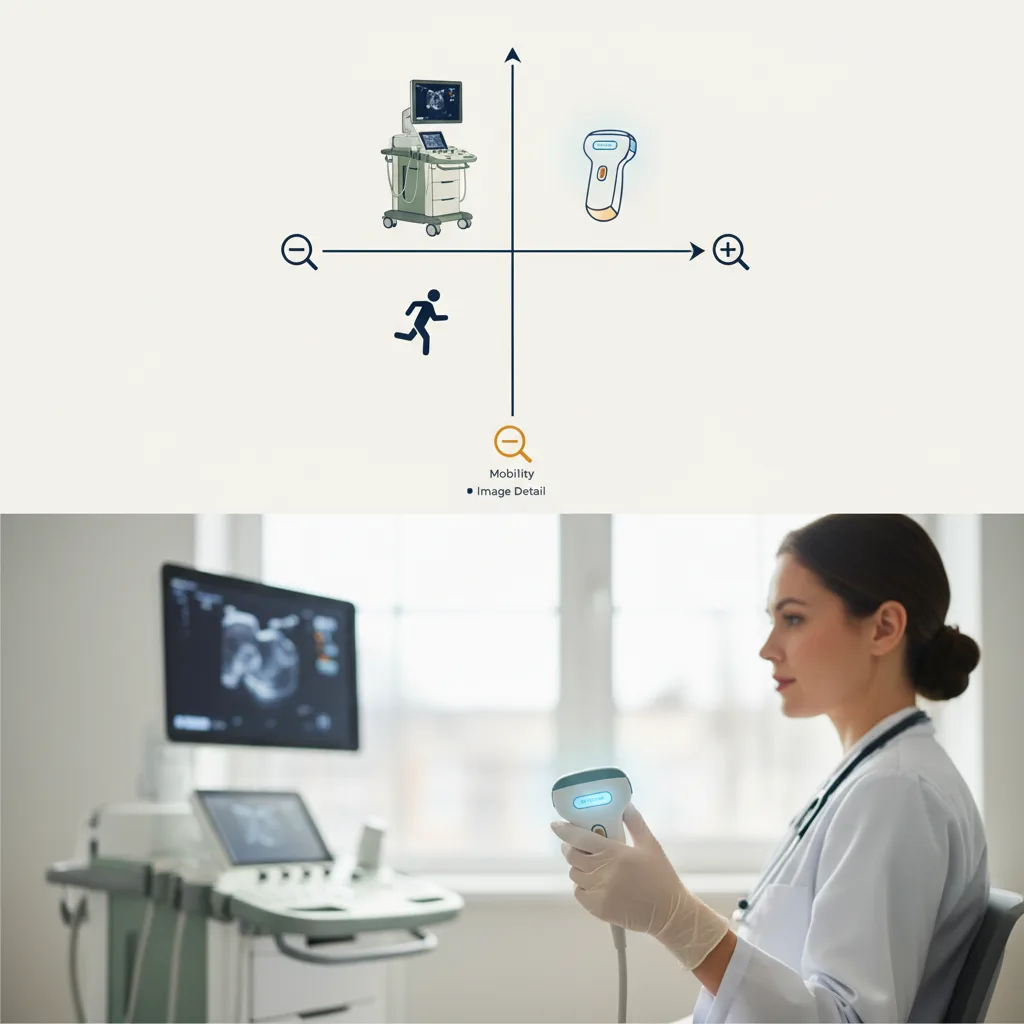
Visual Summary
Key concepts from this article at a glance.

Related Products
Related Articles
Ultrascan vs Butterfly Network: An Honest SA Comparison
Comparing Ultrascan and Butterfly Network devices on price, features, support, and suitability for South African clinicians.
Ultrascan vs Clarius: Which Wireless Probe is Right for You?
A detailed comparison of Ultrascan and Clarius wireless ultrasound probes for SA practitioners.